How can a story help a child feel ready for school?
How to use a personalized story to rehearse school routines, name worries, and build confidence before a new class starts.
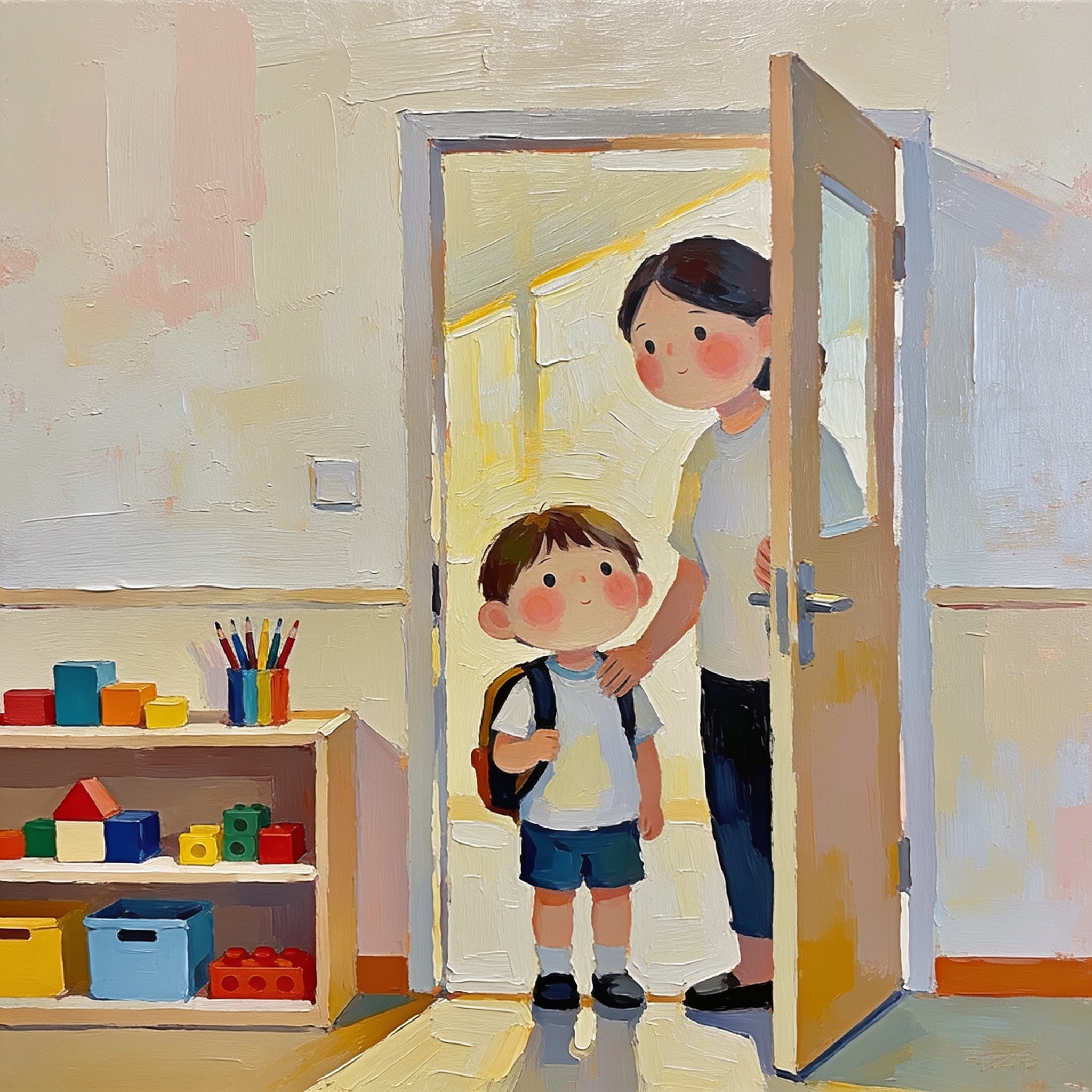
A school-start story helps most when it rehearses the day, names the worry, and gives the child one brave role without pretending school is already easy.
A story can help a child feel ready for school when it turns a vague unknown into a sequence they can picture: getting dressed, reaching the classroom, saying goodbye, meeting one safe adult, and coming home again. It should not promise there will be no tears. It should help the child know what happens next.
That matters because starting school or a new class is a real transition, especially for children who are leaving home routines, changing teachers, or learning to separate at the door. Guidance for families is consistent: children need preparation, predictable routines, honest goodbyes, and patient adults.¹²³
In this guide we look at what a useful school-start story can do, how to adapt it by age, what to avoid, and how to turn a real school worry into a story that still feels like an adventure.
The quick answer
A useful first-day-of-school story does three jobs: it makes the school day concrete, gives language to mixed feelings, and lets the child practice one small act of agency.
Concrete beats cheerful. “You will have fun” is too broad for a nervous child. “You will hang your backpack on the hook, wave at the window, and I will come back after lunch” gives the mind something to hold. NAEYC recommends giving children a specific return time and a concrete activity when saying goodbye in a new school setting.²
The same idea appears in Catalan school guidance for I3, the first year many children enter school. Families are encouraged to talk about activities, friends, schedules, who will drop off and pick up the child, and to read stories where characters also start school.¹
A personalized story can gather those pieces into one safe rehearsal. The school gate becomes part of the plot. The lunchbox, backpack, teacher’s name, family language, or favorite animal can become familiar anchors inside the page.
Reading together is part of the preparation, not an extra lesson. The American Academy of Pediatrics recommends shared reading from birth through at least kindergarten and emphasizes joyful, language-rich interaction around books.⁴
What should a school-start story include before the first day?
The story should include the moments that are hardest to imagine from home: the morning routine, the goodbye, the first friendly adult, and the return.
A map of the morning
Children often cope better when the day has a shape. The American Academy of Pediatrics recommends back-to-school routines around sleep, meals, homework, and after-school care, with enough consistency that the child is not meeting every change at once.³
In story form, that can be simple: the hero chooses socks, finds the backpack, checks the water bottle, walks past the bakery, and reaches the classroom. The point is not to document the morning perfectly. It is to make the first step visible.
A goodbye that tells the truth
A good school story does not let the adult vanish. It shows a short, kind goodbye and a clear return.
For younger children, this might be a hug, one sentence, and a predictable pickup point. Generalitat guidance explicitly warns against leaving secretly or saying “I’ll be back in a moment” when that is not true, because it can create distrust.¹
One familiar bridge from home
The bridge might be an object, a song, a phrase, a family joke, or a tiny ritual. It works best when it is small enough to repeat.
Harvard’s Center on the Developing Child describes routines, adult modeling, and supportive relationships as scaffolding for executive function and self-regulation.⁵ A story cannot build that scaffolding alone, but it can make the scaffolding memorable.
How should the story change by age?
The story should match the child’s real reading moment, not just the school year. A three-year-old starting preschool needs different help from an eight-year-old entering a new class.
Ages 3 to 5: show what will happen
For younger children, the strongest story is concrete and close to home. The hero can visit the classroom, find the coat hook, meet the teacher, miss a grown-up, and discover that the grown-up comes back.
The emotional language should stay simple: nervous, excited, cross, proud, tired. Generalitat guidance notes that every child may need a different amount of time and may show nervousness in many ways, including regressions in habits they had already learned.¹ The story should leave room for that without turning it into a crisis.
Ages 6 to 7: give the child a mission
At six or seven, the story can carry more plot. The hero might learn the map of the school, help a new classmate, remember a secret phrase, or solve a small problem at recess.
This age often needs confidence with a task, not only comfort with separation. The mission should be achievable: ask the teacher one question, find the library, invite someone into a game, or try again after a mistake.
Ages 8 to 9: respect the social worry
Older children may worry less about the door and more about friends, being noticed, making mistakes, or feeling too young for a “school story.” The plot needs to respect that.
For this age, make the personalization less obvious and more specific. A joke, interest, language, sport, music taste, or quiet fear can matter more than repeating the child’s name. If you are unsure whether the tone fits, our age guide for personalized books gives a practical way to check maturity, text density, and reading mode.
What should the story avoid?
A first-day story should comfort without forcing a performance. The child is allowed to be unsure.
Avoid forced happiness
“You will love school” can backfire because it leaves no room for a real feeling. Better: “part of you wanted to go in, and part of you wanted one more hug.”
NICE reviewed school-transition interventions and found some encouraging signals for social and emotional skills, but the evidence is mixed across outcomes and study quality.⁶ That is a useful boundary: stories can support a transition, but they are not a guarantee.
Avoid making bravery mean silence
Bravery is not the absence of tears. For a child, bravery may be walking in with a wobbly voice, asking where the toilet is, holding the teacher’s hand, or trying again after recess feels lonely.
The story should reward asking for help, not pretending not to need it.
Avoid turning school into a test
The first day is not proof that the child is independent forever. It is one morning in a longer adjustment.
NAEYC reminds families not to expect perfection during the first week and to ask first about what was fun before asking what was hard.² A story can follow the same rhythm: start with one good moment, then make space for the hard part.
How can you turn a real worry into a story idea?
Start with the worry, then give the child a role they can actually play.
Use this five-step path:
- Name the school moment: drop-off, lunch, playground, classroom noise, finding the toilet, or meeting the teacher.
- Choose the emotional heart: courage, patience, asking for help, trying again, or feeling two things at once.
- Add one real anchor: backpack, shoes, route, breakfast, favorite phrase, home language, or a small object.
- Turn the worry into a quest: find the classroom star, help a shy dragon, deliver a secret note, or teach a robot the morning routine.
- End with return: the grown-up comes back, the child has one story to tell, and school feels a little less unknown.
Example A child who worries about the playground becomes the keeper of a tiny compass that points to kind voices. The compass does not make everyone a best friend on day one. It helps the hero find one game, one adult, and one way to say, “Can I play?”
Personalization matters here because the useful detail is rarely generic. In a small preschool study, children learned unfamiliar words better from personalized sections of a book than from non-personalized sections, though the study had only eighteen children and measured vocabulary rather than school adjustment.⁷ The broader lesson is careful: personal details can hold attention when they are woven into the story, not scattered like labels.
In Imagibo, the child, companions, world, age, language, illustration style, and the heart of the story shape the book from the start. If the worry is school, the heart might be courage, asking for help, or trusting that a grown-up returns. The free preview lets you read the full story text, see the characters, cover, and first illustrated chapter before deciding whether to order the printed softcover.
Conclusion: prepare the child, not the perfect first day
A school-start story works best when it gives the child a small rehearsal and a true promise: the day has steps, feelings are allowed, and the grown-up comes back.
The goal is not to make school magically easy. It is to make the unknown a little more named, a little more familiar, and a little more theirs.
Create a personalized children’s book with Imagibo. You can shape the hero, their world, and the heart of the story, then read the preview before deciding.
Frequently asked questions
Can a story really help with first-day-of-school nerves?
Yes, a story can help by rehearsing routines, naming feelings, and giving the child words for what will happen. It should support real preparation and adult reassurance, not replace them.
Should the story say school will be fun?
It can include fun, but it should not promise only fun. A stronger story says school may feel new, loud, or strange at first, and then shows one safe adult, one routine, and one way to ask for help.
What age is best for a school-start story?
It can work from preschool through the early primary years if the tone changes. Younger children need concrete scenes and repetition; older children need a plot that respects friendship, mistakes, and independence.
What details should I include in a personalized school story?
Include details that lower uncertainty: the route, backpack, classroom, teacher, pickup plan, home language, or a comfort ritual. Add one interest the child loves so the story still feels like their adventure.
What if my child cries at drop-off after reading the story?
The story has not failed. Many children still need time to adjust. Keep the goodbye honest and predictable, and speak with the teacher or pediatrician if anxiety persists, worsens, or disrupts daily life.
Should the story mention the actual school name?
Only if that feels helpful and you are comfortable using it. A story can work just as well with a classroom, teacher, playground, or morning route described more generally.
Sources
¹ I3, comencem l’escola - Departament d’Educació i Formació Professional ² Transitioning to Kindergarten - NAEYC ³ Back-to-School Tips for Families - HealthyChildren.org ⁴ Shared reading from birth through kindergarten - American Academy of Pediatrics ⁵ Three Principles to Improve Outcomes for Children and Families - Center on the Developing Child at Harvard University ⁶ Evidence reviews for transition support interventions - NICE / NCBI Bookshelf ⁷ Reading personalized books with preschool children enhances their word acquisition - First Language