How a big-sibling story can help when a new baby arrives
What a useful big-sibling story should say, avoid, and make room for when a child is adjusting to a new baby.
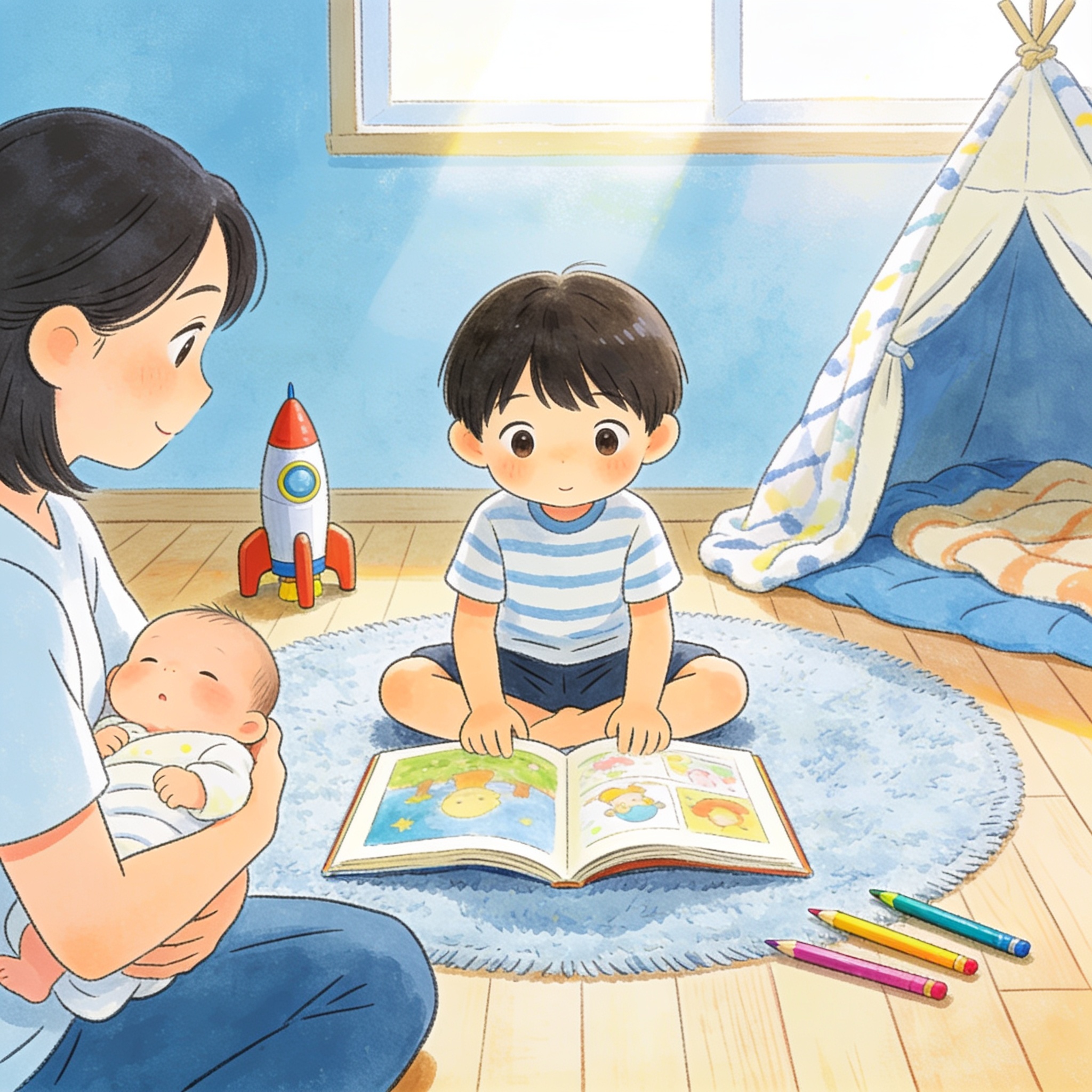
A good big-sibling story does not tell a child to be happy. It helps them see that they still have a place, a voice, and a role in the family story.
A story can help an older child when a new baby arrives if it keeps the older child at the center, names the change honestly, and gives them language for more than one feeling. The useful story is not a lecture about being kind to the baby. It is a small rehearsal for a family shift.
That matters because a new sibling changes the daily world a child knows: attention, routines, visitors, noise, sleep, and the way adults talk. Pediatric guidance is consistent on one point: children adjust better when they feel included, still loved, and prepared in language they understand.¹²
In this guide, we look at what a big-sibling story should include, what it should avoid, and how to turn a real family detail into a story that comforts without pretending the change is easy.
What should a big-sibling story do first?
A big-sibling story should first protect the older child’s place. The baby may be the reason for the gift, but the older child is the reader who needs to feel seen.
Research on the transition to siblinghood describes it as a real family reorganization, not a tiny side event. Some firstborn children show disruption, some grow into the new role smoothly, and some barely change at all.³ That range is the point. A useful story should not assume jealousy, but it should leave room for it.
The simplest test is this: if you removed the baby from the story, would the older child still have a real adventure? If the answer is no, the book may be about the baby with a “big sibling” label pasted on top.
Keep the older child as the hero
The main decisions should belong to the child becoming a sibling. They find the clue, ask the question, choose the path, calm the dragon, open the door, or invite the baby into their world.
This is why a personalized big-sibling story works best when it begins with what the older child already loves: dinosaurs, football, painting, trains, sea creatures, music, a local park, a cousin, a pet. The new baby enters a world that was already theirs.
Name the change without making it scary
Children do not need every adult detail, but they do need honest expectations. Nemours KidsHealth recommends explaining that babies cry, need time and attention, and may not be ready to play for a while.²
In a story, that can become a scene where the baby sleeps through the adventure, cries at the wrong moment, or needs gentle help. The older child learns what is changing without being asked to perform instant maturity.
Preserve one familiar routine
HealthyChildren, from the American Academy of Pediatrics, advises keeping special time for the older child and avoiding too many big routine changes around the baby’s arrival.¹ In story terms, a familiar bedtime song, Saturday walk, kitchen chair, or goodnight ritual can become an anchor.
The message is quiet: some things are changing, and some things are still yours.
Sibling relationships can later become a real setting for learning feelings, intentions, play, and conflict.⁶ The first story does not need to force that bond. It can simply make the new relationship less abstract.
Which emotions should the story allow?
A good big-sibling story should allow curiosity, pride, annoyance, worry, boredom, love, and jealousy to coexist. Mixed feelings are not a failure of the child or the family.
UNICEF’s parenting guidance recommends age-appropriate honesty, including the good parts and the difficult parts of having a baby at home.⁴ That same balance belongs in the story. If every page insists that the older child is thrilled, the book may miss the child who is actually listening.
The most reassuring line in a big-sibling story may be the one that says two feelings can be true at once.
Joy without pressure
Some children love the baby quickly. Some need time. KidsHealth is clear that a lack of interest in the newborn is not alarming and should not be forced.²
So the story can show affection as an invitation, not a duty. The hero might wave, sing, bring a blanket, or simply decide to keep reading while the baby listens.
Jealousy without shame
Jealousy often comes from a child’s fear that their place has changed. The article does not need to use the word jealousy, especially with younger children. It can show a character feeling left out when visitors crowd around the baby, then finding a way to be noticed without being scolded for wanting attention.
That is different from rewarding every behavior. It lets the feeling exist while keeping boundaries around what the child does next.
Pride without parentification
Being a big sibling should not mean becoming a tiny adult. HealthyChildren and KidsHealth both suggest simple, age-appropriate ways for children to help, such as choosing clothes, talking to the baby, or helping with small routines.¹²
In a story, the older child can have a special role without carrying adult responsibility. They are important because they are themselves, not because they are useful.
How can a story fit different ages?
The best big-sibling story changes with the child’s age. The same family event feels different at three, six, or eight.
Ages 3 to 5: make the change concrete
Younger children need visible scenes and simple cause-and-effect. A good story might show the baby crying, the parent feeding them, and the older child choosing a quiet game or bringing a soft toy.
Keep the adventure close to home: the sofa becomes a boat, the hallway becomes a tunnel, the baby’s blanket hides a tiny map. The child does not need a speech about family systems. They need a picture of what tomorrow might feel like.
Ages 6 to 7: give the child a mission
At this age, many children enjoy a clearer quest. The story can give the older sibling a mission that depends on something only they know: the route through the park, the song that calms the house, the code word for a secret den.
This lets the new role feel active without making the baby the whole plot.
Ages 8 to 9: respect their mixed inner life
Older children may understand the change but still feel pushed aside. A useful story can handle more subtlety: missing how things were, wanting privacy, feeling proud and irritated on the same day.
The adventure can include a real choice. The hero may decide when to invite the baby into their world and when to keep one corner of it for themselves.
What should you avoid in a big-sibling book?
Avoid stories that flatten the older child into a lesson. A baby is not a moral exam.
Children’s books can give a safe way to explore feelings and situations. A pediatric bibliotherapy review describes books as a medium for exploring concepts, feelings, attitudes, and the child’s environment.⁵ But that only works when the story respects the child’s actual problem.
Avoid “you must be happy now”
Excitement may come, but it cannot be demanded. A story that only praises happiness can make a confused child feel wrong.
Use wonder instead: the baby is strange, small, noisy, sleepy, soft, surprising. Curiosity is often a kinder doorway than celebration.
Avoid replacing the child with the role
“Big brother” or “big sister” is a new role, not a new identity. The child still has their own tastes, friends, memories, and favorite jokes.
The story should use the role as one part of who they are. It should not erase everything that made the child recognizable before the baby arrived.
Avoid making the baby the prize
The story should not end with the older child earning love by accepting the baby. They had love already.
A stronger ending shows continuity: the family is bigger, the older child’s place remains, and the adventure gives them a way to understand the change.
How do you turn the family change into a story idea?
Start with one true detail about the older child, then connect it to the arrival of the baby.
Try this short path:
- Choose something that already belongs to the child: a place, object, habit, animal, game, or obsession.
- Choose the emotional heart: patience, asking for help, confidence, gentleness, curiosity, or making room for more than one feeling.
- Decide how the baby appears: as a sleeping companion, a mystery to understand, a tiny listener, or a future teammate.
- Keep one familiar adult or routine in the story.
- Let the older child solve something meaningful.
For example: a child who loves maps finds a tiny route through the house on the morning the baby comes home. Every clue leads to a place that still belongs to them: their bookshelf, their breakfast chair, the plant they water, the blanket used for evening stories. The baby is part of the ending, but the older child’s world carries the adventure.
At Imagibo, this is exactly the kind of detail the creation flow is built to use. You choose the child, companions, world, and the heart of the story; the free preview lets you read the complete story before deciding whether to order the printed book.
In one small experiment with 18 preschoolers, children showed better knowledge of words embedded in personalized book sections than of words in non-personalized sections after the reading sessions.⁷
Conclusion: make room before you make a moral
A big-sibling story is useful when it does three things at once: it keeps the older child central, tells the truth about change, and gives the family a gentle script for reading together.
The best version is not generic. It uses the child’s real world so the new role feels connected to who they already are.
Create a personalized big-sibling book with Imagibo. You can start from the child’s world, include the new baby if you choose, and read the full story before buying the printed copy.
Frequently asked questions
Can a story really help a child adjust to a new baby?
Yes, a story can help by giving the child language, rehearsal, and a shared moment with an adult. It should support real attention and conversation, not replace them.
Should the baby be a main character?
Usually no. The baby can appear, but the older child should remain the hero. That keeps the story from becoming another moment where all attention moves to the newborn.
What if my child is not excited about becoming a sibling?
Do not force excitement. Use a story that allows curiosity, worry, jealousy, and affection to appear slowly, and keep one-on-one time outside the book as well.
What age is best for a big-sibling story?
It works best when the story matches the child’s stage. For children around 3 to 9, the language, plot complexity, and emotional detail should change with age.
Is a personalized story better than a standard big-sibling book?
It depends on the child. A standard book can introduce the idea well; a personalized story is useful when you want the child’s own people, routines, places, and feelings to shape the adventure.
Should a big-sibling book promise that everything will be easy?
No. The more helpful promise is that the child still belongs. A story can be warm and hopeful without pretending that a new baby changes nothing.
Sources
¹ Preparing your older child for a new baby - HealthyChildren.org
² Preparing your child for a new sibling - Nemours KidsHealth
³ Family transitions following the birth of a sibling - PubMed
⁴ How to prepare your child for a new sibling - UNICEF
⁵ Children’s books for use in bibliotherapy - Journal of Pediatric Health Care
⁷ Reading personalized books with preschool children enhances their word acquisition - First Language